Greece 2008
Home Who is Going? Registration Greece Information

   
Greece Italy Home Who is Going? More about Greece Italy Turkey Registration


The SSQQ 2008 Cruise to Greece

A Trip to the Birthplace
of the Western Civilization!

Sunday, July 20th - Sunday, July 27th
Aboard Royal Caribbean Navigator of the Seas

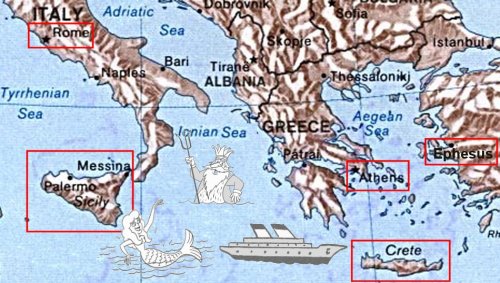
Day One:  Rome, Italy -- Depart at 5:00 pm

Day Two:  Sicily, Italy-- 10:00 - 6:00 pm

Day Three: Cruising the Mediterranean

Day Four: Athens, Greece - 7 am - 7 pm

Day Five: Ephesus, Turkey -- 7 am- 7 pm

Day Six: Heraklion, Crete -- 7 am - 3 pm

Day Seven: Cruising the Mediterranean

Day Eight: Rome, Italy -- Arrive 5:00 am

Come experience the wonders of ancient civilizations on our next SSQQ cruise vacation.  We set sail on July 20th aboard The Navigator of Seas, one of Royal Caribbean’s finest ships

This trip will be expensive.  There is no getting around that.  However, I will guarantee you that it will be a once in a lifetime experience!  What better way to explore this part of the world than sharing the adventure with all your friends.  Where else can you combine so much history, natural beauty,  rich culture and tradition,  all the while dancing your way across the magnificent Mediterranean Sea.

We are visiting the cradle of civilization. There is so much to see that you will go crazy having to choose one exciting destination over another.  Will it be a trip to explore ancient ruins or an expedition to witness spectacular mountain vistas and enjoy the compelling natural beauty?  Or will it be a chance to view the rich architectural and historical heritage, or just visit one of the many stunning beaches?  Will you make a trip to Mount Etna, Europe's largest active volcano, or will you visit The Vatican?  These will be tough decisions, but whatever you choose, you can't miss.

Please note that Marla Archer researched and collected all the information on this main page. 

In addition, Rick Archer & Samantha Archer made further contributions that can read on the Greece Information Page.

Rome

St Peters, Rome

The Ruins of the Roman Forum

 Rome, Italy

Day One

Our cruise departs on Sunday from Civitavecchia, Italy at 5:00 pm in the eveningWhy not come a day or two early to explore Rome, Italy’s most populous and famous city in even greater depth.

Civitavecchia is the gateway to all the magnificence of the ancient city of Rome.

Whether it's the Forum, the Sistine Chapel, the Pantheon or St. Peter's Basilica that sparks your interest and intellect, Rome is home to a lifetime's worth of historical, architectural and spiritual sites. Depending on traffic, the drive from Civitavecchia to Rome takes approximately an hour and a half.

Experience the history of Rome as you wander around the Colosseum, one of the most important monuments of ancient Rome and the Roman forum.   A masterpiece of classical architecture, the Colosseum is an enormous amphitheater where gladiators, Christians and wild beasts once battled to the death in front of 55,000 spectators.  Upon completion, spectacular 100-day celebrations were organized as part of the opening ceremony in 72 AD. Its name is believed to come from Nero's enormous statue of Colossus that stood close by. The admission charges are about EUR10.
 
The Forum was designed to be the centre of social, political and economic life in the city. The innumerable remains include the well-conserved triumphal arch of Emperor Septimius Severus, with reliefs depicting his victories and the base of the Temple of Saturn with its eight columns and their splendid Ionic capitals. The 'Rostrum' is the famous platform from which Mark Antony gave his oration in Shakespeare's play after Julius Caesar's assassination. The platform became the setting for many important events in Rome's history. It was named the 'rostrum' after the bows of the ships that form the decorative motif. The Temple of Vesta was the home of the Vestal Virgins, charged with keeping the sacred flame alight. The circular foundations still remain, near to a garden in which traces of the House of the Vestal Virgins can still be seen. The Basilica of Constantine and Massentius was used as the court, and the three remaining barrel-vaulted naves give an idea of its gigantic structure. The Arch of Titus celebrates victories in Judea, and in the reliefs you can see the spoils of war, including an altar and a seven-armed chandelier. Admission is free; guide tours in English cost EUR3.20


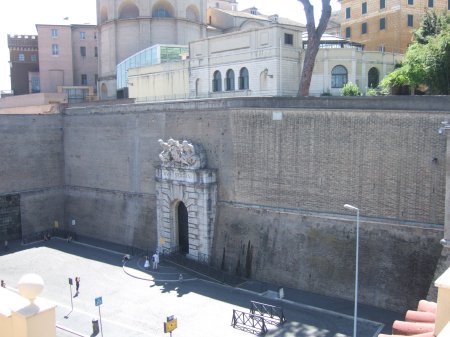
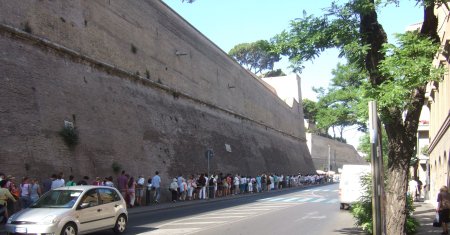
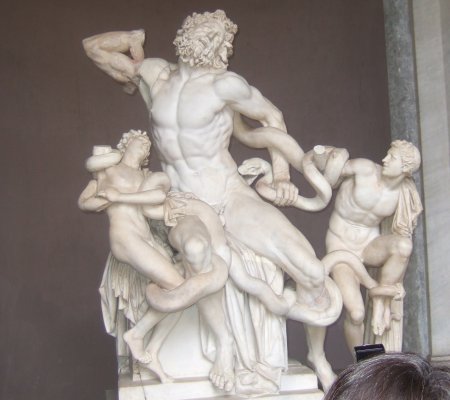
Visit the Vatican Museum, where you can walk through the many rooms that house the largest art collection in the world. 
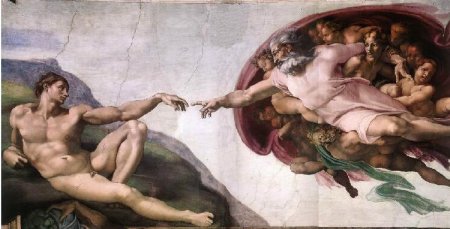
The Vatican is among the most important historical sites in the world. The seat of the Holy Roman Catholic Church, The Vatican is also the home of the Pope. As the smallest state in the world, the Vatican has figured in key events throughout history. Occupying about one half kilometer of Rome, The Vatican is further significant because of its fabulous architecture, religious, and artistic treasures. It was Pope Julius II della Rovere in the 16th century who commissioned Michelangelo to paint the history of creation on the ceiling of the Sistine Chapel. Among countless other notable events in the history of this important city are the convening of the College of Cardinals, at the death of a reigning Pontiff, for the purposes of electing a new Pope. No visit to Rome is complete without an excursion to The Vatican, a place so steeped in history and tradition that you will never forget it.

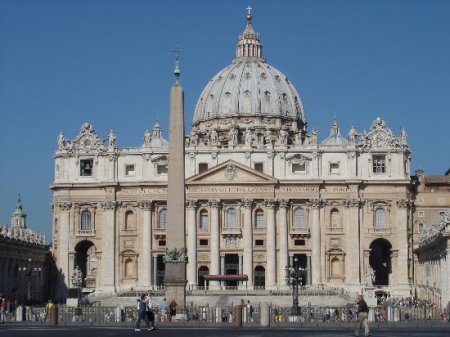
Travel through the magnificent St. Peter’s Basilica, the largest church in the world. . Construction began in 1452 on the site where St. Peter was buried and took over 100 years to build.  It rests on 800 pillars and is littered with 44 altars.   During the next 200 years, such famous masters as Bramante, Michelangelo, Raphael and Bernini worked on its design and created an unparalleled masterpiece.  View Michelangelo's "Pieta" and the 85-foot-high Bernini Pulpit.   Admire one of the many masterpieces created by Michelangelo, the famous statue of Moses. This majestic bearded figure is depicted holding the tablets of the Ten Commandments.  

If this is your first visit
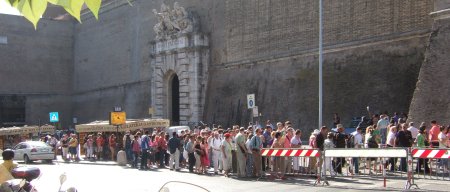
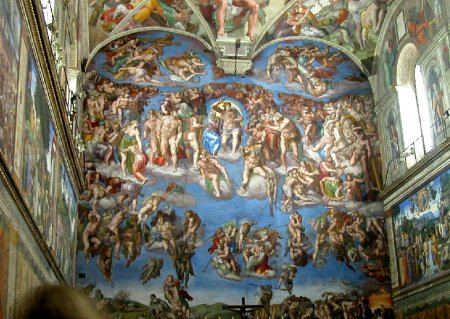
to Rome time, you must take in the Sistine Chapel.  It is considered a masterpiece of Renaissance art.   Dominating the chapel is Michelangelo’s ceiling paining of the “Creation of the World.”.  The Sistine Chapel receives 50 million monthly visitors.  The Chapel was built somewhere between 1477 and 1481 by Pope Sixtus IV.  From 1480 to 1483, famous artists of Renaissance, such as Botticelli, Perugino, and Ghirlandaio, decorated the walls. After twenty years, Julius II commissioned Michelangelo to decorate the ceiling in 1508. Today, after the restoration, tourists can visit the chapel and see Michelangelo's “Last Judgment.”  You will invariably find the Sistine Chapel crowded with hundreds of tourists, so be prepared. The best way to see it is to go to the Vatican Museums early, so that you're among the first in line when they open. Silence should be observed and photography is not prohibited.

The Pantheon was commissioned by Marcus Agrippa, restored by Domitian, and subsequently rebuilt by Hadrian (who added the dome) before being turned into a church in the early 7th century by Pope Boniface IV. The building's sole source of light is the opening at the dome's apex (the oculus); according to popular legend, this formed the base for the bronze pinecone that is now in the Vatican's 'Pigna' courtyard, where it is used as a fountain. Many famous Italians are buried in the Pantheon, including Renaissance painter Raphael and King Vittorio Emanuele I.

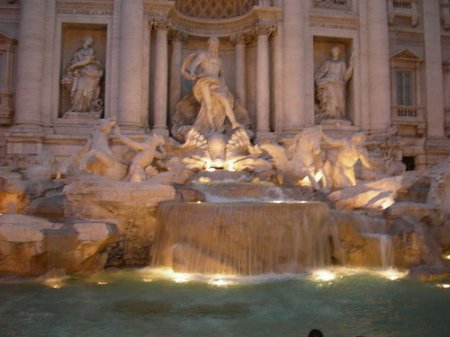
No visit to Rome can be complete without a stop at the Fontana di Trevi.
  Tradition has it that throwing a coin over your left shoulder into the fountain guarantees a swift return to the world's most beautiful city. Anita Ekberg's dip in it was immortalized in Fellini's 'La Dolce Vita', and Italian actor Toto even sold it to an American, passing himself off as its owner. Earlier it was the setting for the award-winning "Three Coins in the Fountain" motion picture, ensuring its popularity worldwide. Designed by Nicola Salvi for Pope Clemente XII, it was completed in the second half of the 1700s. The statues in the centre represent Neptune supported by Tritons on either side while rococo-style Poli Palace provides the perfect backdrop.

If time permits, take a visit to Trastevere on Sunday morning.  T
his area of Rome was originally built to be a city port where storehouses held goods at the time of Augustus and continued to do so until the end of the 19th century. Trastevere then became a downtown market residential quarter and has now developed into a very desirable quarter. The heart of the district is Piazza di Santa Maria in Trastevere with its lovely church, a 17th century palazzo and a fountain in the middle which is probably Rome's oldest, having been designed by architects such as Bernini, Fontana and Della Porta. There are still some well-conserved medieval houses   On Sunday mornings, you can visit the 7th Corte dei Vigili in Via dei Salumi, and if you enter the guards' rooms, you will see grafitti on the walls written by Roman soldiers who served the emperors from Septimus Severus to Caracalla, in addition to notations of their guard duty.

If you have the extra time, explore the flavors and history of Etruscan Italy. Pre-dating the Roman Empire, the Tuscia region has been the cradle of the Etruscan civilization and is evident in hilltop Tuscania, with its roots dating from the 9th century B.C., contrasting with the Renaissance gardens, fountains, pavilions and maze of Villa Lante.

Leaving the port area and heading north from Civitavecchia, you will view the warm colors of the Etruscan countryside.  Make your way to Bagnaia. Stop by and appreciate a visit to the Renaissance gardens of Villa Lante. To create these beautiful gardens, one of the greatest architects of the time, Vignola, was called upon. Fountains, pavilions and a box-tree maze were all combined to create a peaceful yet playful atmosphere. Walk through these inspirational and often whimsical gardens, taking time to enjoy the serenity and beauty of the setting. Then proceed to the lake of Bolsena and stop for views of the lake and the islands Bisentina and Martana  Standing at the top of a rocky hill overlooking the Maremma region, Tuscania’s Etruscan and Renaissance buildings have been beautifully restored and still reflect the Etruscan history. Walk through the narrow cobblestones lanes of this charming village and take in the views of the surrounding valleys.

The Euro, the currency of the European Union is the official currency in Italy. Many stores and restaurants accept major credit cards, which usually offer a good exchange rate.  When shopping remember there is a value-added tax to most purchases.

Depending upon the size of our group, we will have our SSQQ Welcome Aboard Cocktail party this evening. Meet your fellow SSQQ Cruise passengers and enjoy unlimited cocktails and dance to your favorite tunes as we sail along Italy's coastline.

Victor Emanuel Monument

Roman Coliseum, One the new Wonders of the World

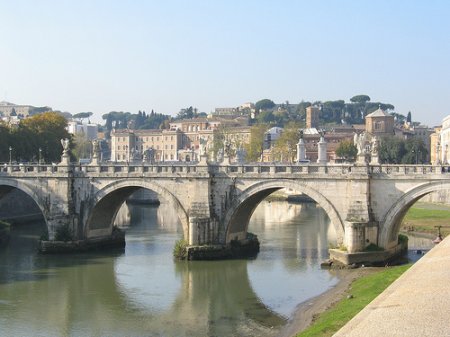
Castle Saint Angelo

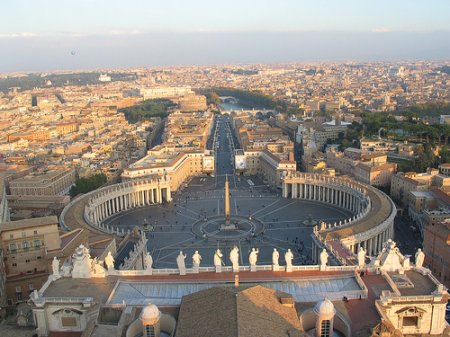
View from the Basilica

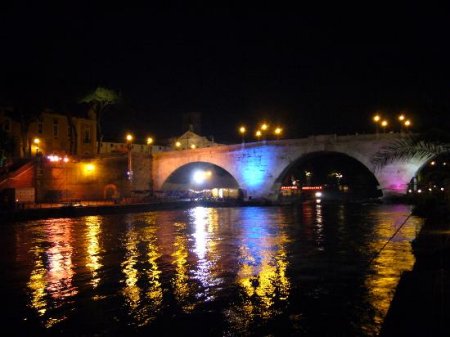
Trastavere at Night

Villa Borghese Grounds

St Peter's Basilica

Trevi Fountain

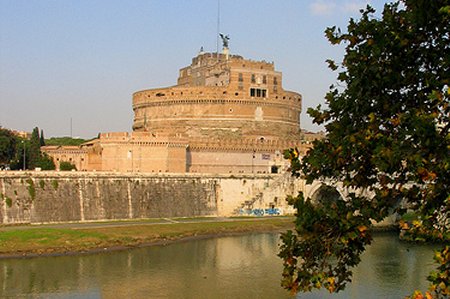
Castle Saint Angelo

The Roman Coliseum

Sicily

Mount Etna, Sicily

Beach in Sicily

Sicily

Day Two


We arrive at the port town of Messina on the island of Sicily at 10:00 am on Monday. 

Sicily is an amazing island with a rich architectural and historical heritage, not to mention compelling natural beauty.  It can be overwhelming in many different ways, especially for a first time visitor.  The following is a list of highlights -- by no means all-encompassing -- but at least one that will serve as a guide.

Messina is just three miles off the coast of southern Italy’s mainland. This bustling town has a complex history with roots in Greek mythology but because of an earthquake in the early 1900s, it's a relatively young city architecturally. Since the majority of the city has been rebuilt or refurbished within the last 100 years, you'll find the town has an interesting blend of new architecture and old styles.

For a show unlike any you've seen before, check out the world's largest astronomical clock, Orologio Astronomico, in the Piazza del Duomo. It's set in a 197-foot bell tower and when the clock strikes noon, it comes to life. As Ave Maria begins playing from a loudspeaker, the bronze mechanical figures start to move. A lion roars, a bird flaps its wings, and two historical heroines take turns ringing the bell, all before it ends with a statue of Jesus appearing from a tomb.

Other things to do in Messina include taking a walk through the Duomo, the town’s main cathedral in the Piazza del Duomo.  Although most of it has been refurbished in recent years, it has retained some of the original Norman-style features from 1160, when the Holy Roman Emperor Henry VI built it.

Stop and make a wish in the Fontana di Orione in the center of the piazza.  The pre-baroque-style fountain was built to commemorate Messina’s aqueduct and symbolized the four rivers, Tiber, Nile, Ebore and Camaro.

Spend some time in the Museo Regionale.  Here you’ll find an amazing collection of art rescued from the1908 earthquake, including pieces dating back to the 13th century.

  If you are more adventurous, a trip to Mount Etna is a highlight for any visitor to this area.  Enjoy a scenic ride to Europe's largest active volcano. While en route, enjoy the delightful countryside of vineyards and orchards. The winding road up the slope passes through vast lava fields to the Silvestri Spent Craters, almost 6,000 feet above sea level. There you will be able to walk along the brim of these craters.  You can  see remnants of past eruptions.  The road cuts among streams of solidified lava -- a black, petrified river flowing from the top of the mountain. More than 130 eruptions have been recorded since the 4th century BC; the most recent one occurred in 2002. The descent offers awe-inspiring views of volcanic cones and streams of hardened lava. Although the best views of the actual peak of Mt. Etna are from the distance of many miles, a closer inspection of its powerful destruction cannot help but impress any visitor.

Take a tour to the well-known resort community of Taormina renowned for its beautiful setting.  It is perched on a mountainside on the West Coast of Sicily.

Stop below the village of Taormina before proceeding uphill to the village gates. Upon reaching Taormina, you'll walk past the ancient village's many squares and see the small boutiques located along the Corso Umberto.   Here you will find the "essence of Sicily," Taormina. Built in the 3rd century BC, the city was later almost completely renovated by the Romans. Taormina is perched on a terrace overlooking the sea.  It’s medieval character will delight you. Near the center of Taormina, you will find cobblestone streets to Palazzo CORVAIA, a 15th century building adorned with classic double windows. Proceed to the impressive Greek Theater, built in the 3rd century BC. Renowned for its width and for its unique acoustic qualities, it is still used for open-air concerts. Weather permitting; you will have an impressive view of Mt. Etna.

Enjoy the busy main street with its numerous shops and cafes and to savor the charm and atmosphere of this small medieval town with its palaces, squares, staircases and small side alleys.

A visit to the town of Palermo would be another choice.  Palermo is home to the island’s best museums.  It is one of several, well kept medieval towns that should be explored.  The streets of Palermo can seem dirty, polluted, and just plain annoying, particularly for those who enjoy exploring the city by foot; Palermo is pedestrian-unfriendly in the sense of having some extremely narrow sidewalks and walkways, and fast drivers who like to drive awfully close to pedestrians, but don’t let that deter you from exploring Palermo’s richness, including: the Palatine Chapel and the Monreale Duomo.

Palermo's history is marked by the multitude of conquerors and subsequent cultures that settled there. The Phoenicians, Carthaginians, Byzantines, Arabs, Normans, Romans, French Angevins, Spanish Aragonese, and even the Mafia are among those who have contributed to Palermo's collective cultural history. The resulting cultural blend emanates from Palermo's buildings, art, and people. From the Cappella Palatina with its stunning biblical mosaics and Arab-style stalactites and alveoli ceiling to the Quattro Canti, a city square in the heart of Palermo containing four seventeenth-century palaces, Palermo has played host to those seeking adventure for centuries.

Taormina Overlook

Taormina Town Square

Sicilian countryside

Taormina

Palermo Theater

Sicilian Coastline

Silvestri Crater

Athens

Acropolis at night

Red Beach

Athens, Greece

Day Four


We arrive in Athens on Wednesday at 7:00 am.  The ship doesn’t depart until 7:00 pm, so you have a full day to explore this magnificent city.

Athens is situated in the prefecture of Attica and extends to the peninsula that reaches up to Central Greece. Mountains to the north and east, and the Sardonic Gulf to the south and west surround Athens. The sun shines over Athens all year round. The climate is one of the best in Europe. It is located just a few miles from the port of Piraeus, the central commercial port of the capital, and the shores of southern Attica.  Piraeus is the main port of Athens, the biggest in Greece, and one of the most important in the Mediterranean Sea. Piraeus is walking distance from Kastella, a hill strewn with beautiful houses that offers a majestic view of the Saronic Gulf.

Athens has constantly been inhabited since Neolithic Age. The 5th century was the time of its ultimate bloom, when moral values and civilization surpassed city limits and became the motherland of western civilization. In the centuries that followed, many conquerors tried to take over Athens. In 1834 Athens was chosen to be the capital of the newly established Greek State. The city that now hosts more than 4,5 million people was constructed around the Acropolis walls. Today it is the political, social, cultural, financial and commercial center of Greece.

Athens is a city of different aspects.  Take a walk around the famous historic triangle (Plaka, Thission, Psyri).  This old neighborhood reveals the coexistence of different eras. You will find old mansions, some are well preserved and others are worn down by time. There are also luxurious department stores, small intimate shops, fancy restaurants and traditional taverns. Traditional handicrafts, though sometimes expensive, are the most authentically Greek souvenirs. In Athens, Monastiraki and Plaka are the best places to purchase handcrafted goods. Experience the traditional flea market. You'll find ceramics, brightly colored embroidery and wall hangings, flokati rugs and tapestries. 

The heart of Athens beats in Syntagma Square. This is where Parliament and most of the Ministries are.  A few miles from the historic center, you can enjoy the sea breeze. Or you can head up north and enjoy the fresh air at the more classy neighborhoods of Marousi, Melissia, Vrilissia and of course Kifisia.

Athens and Attica in general have the most important archaeological monuments (Acropolis, Odeion of Herodes Atticus, Olymbion, Roman Market, Panathinaiko Stadium and The Temple of Poseidon.) The capital has many imposing neoclassic buildings, The Greek Parliament and  Athens Academy and University. Don't miss visiting the museums hosting unique treasures of Greece’s cultural inheritance.

Take a visit to
The National Archaeological museum .  It ranks among the top ten museums in the world.  By far the most important museum in Greece, this collection contains artistic highlights from every period of ancient Greek civilization, from Neolithic to Roman times. It houses some of the most important artifacts from a variety of archaeological locations around Greece. The exhibitions can be traced to the development of the Art of Greece from the prehistoric days to the golden age of Greek thought, and all the way to the Roman times.

Holdings are grouped in five major collections: prehistoric artifacts (7th millennium BC to 1050 BC), sculptures, bronzes, vases and minor arts, and Egyptian artifacts. The museum's most celebrated display is the Mycenaean Antiquities. Here are the stunning gold treasures from Heinrich Schliemann's 1876 excavations of Mycenae's royal tombs: the funeral mask of a bearded king, once thought to be the image of Agamemnon but now believed to be much older, from about the 15th century BC; a splendid silver bull's-head libation cup; and the 15th-century BC Vaphio Goblets, masterworks in embossed gold. Mycenaeans were famed for their carving in miniature.

Other stars of the museum include the works of Geometric and Archaic art (10th-6th centuries BC), and kouroi and funerary stelae (8th-5th centuries BC), among them the stelae of the warrior Aristion signed by Aristokles, and the unusual Running Hoplite (a hoplite was a Greek infantry soldier). The collection of Classical art (5th-3rd centuries BC) contains some of the most renowned surviving ancient statues: the bareback Jockey of Artemision, a 2nd-century BC Hellenistic bronze salvaged from the sea; from the same excavation, the bronze Artemision Poseidon (some say Zeus), poised and ready to fling a trident (or thunderbolt?); and the Varvakios Athena, a half-size marble version of the gigantic gold-and-ivory cult statue that Pheidias erected in the Parthenon.

No visit to Athens would be complete without a visit to the Acropolis. There you'll find the Parthenon, the largest building in the Acropolis and one of the world's most awe-inspiring sights. It was built as a temple to Athena and is still a remarkable structure today.

The Acropolis has been nominated to be one of the 7 wonders of modern world. In fact this trademark of Athens is one of the favorites. The Holy Rock of Acropolis dates back to the 5th BC, the famous Golden Age of Periklis.   Acropolis in Greek literally means “the highest point of the town”.

The Acropolis hill (acro - edge, polis - city), so called the "Sacred Rock" of Athens, is the most important site of the city and constitutes one of the most recognizable monuments of the world. It is the most significant reference point of ancient Greek culture, as well as the symbol of the city of Athens itself as it represents the apogee of artistic development in the 5th century BC.

The Acropolis rock is part of a Late Cretaceous limestone ridge that cuts through the Attica plateau in the northeast to the southwest axis and includes the Likavitos hill, the Philopappos (Museum) hill, the hill of the Nymphs, and the Pnyx.  The rock rises from the basin about 70 meters and levels to a flat top 300 meters long by 150 meters wide. Its flat top is due to the numerous landfills that have accommodated construction of fortifications and temples since the Mycenaean era. With its many shallow caves, the abundant percolating water springs and steep slopes, the Acropolis was a prime location for habitation and worship location for Neolithic man.  The Propylaea are the monumental entrances to the sacred area dedicated to Athena, the patron goddess of the city. Built by the architect Mnesicles with Pentelic marble, their design was avant-garde. To the south-west of the Propylaea, on a rampart protecting the main entrance to the Acropolis, is the Ionian temple of Apteros Nike, which is now being restored.

The first habitation remains on the Acropolis date from the Neolithic period. Over the centuries, the rocky hill was continuously used either as a cult place or as a residential area or both. The inscriptions on the numerous and precious offerings to the sanctuary of Athena (marble korai, bronze and clay statuettes and vases) indicate that the cult of the city's patron goddess was established as early as the Archaic period (650-480 B.C.).

The Parthenon is the most famous surviving building of Ancient Greece and one of the most famous buildings in the world. The Parthenon has stood atop the Acropolis of Athens for nearly
2,500 years and was built to give thanks to Athena, the city's patron goddess, for the salvation of Athens and Greece in the Persian Wars. The building was officially called the Temple of Athena the Virgin; "Parthenon" comes from the Greek word parthenos, "virgin."

Throughout its long life, the Parthenon has functioned most importantly as a Greek temple, but has also been a treasury, a fortress, a church, and a mosque. Today, it is one of the most recognizable icons and popular tourist attractions in the world.


Athens has always attracted peoples' attention, most notably for being the birthplace of the Olympic Games.

It was the Panathenaic Stadium, which hosted the 1st Olympic Games of the modern era, in 1896. However, its history goes way before the 19th century AD. The site of the Panathenaic Stadium was originally a small natural valley, between the two hills of Agra and Ardettos, over Ilissos river. It was transformed into a stadium by Lykourgos in 330-329 BC for the athletic competitions of "Panathinea", the greatest festivities in ancient Athens.

Between 140 and 144 AD, Herodes Atticus restored the Stadium, giving it the form that was found at the 1870 excavation: the horseshoe construction with a track 204.07 meters long and 33.35 meters wide. It is believed that the Stadium had a seating capacity of 50,000 people.

The modern times restoration of the Stadium was conducted at the end of the 19th century, for the first Olympic Games that were reborn in 1896. The Stadium was rebuilt with marble from Mt Penteli, the same kind that was used 2,400 years before, for the construction of the Parthenon on the Acropolis. It could now hold over 60,000 spectators. The total cost was 1 million GrD, a huge amount of money in those days.

A visit to the Stadium is an absolute "must" when in Athens. It is located in the centre of the city, on Vassileos Konstantinou Avenue, on the east side of the National Gardens.

Would you like to read more about our Trip to Greece?  This article was researched by Rick Archer.  It appeared in the December 2007 SSQQ Newsletter.

THE 2008 SSQQ TRIP TO GREECE

Temple of Zeus

Greek fishing village

Greek coastline

Acropolis close-up

Parthenon

Acropolis in the daytime

Temple of Dionysus

Panathenaic Stadium, home of the first modern Olympics

Poseidon

Ephesus, Turkey

Kusadasi Port, gateway to Ephesus

another look at Kusadasi Port

Ephesus  

Day Five

We arrive at Kusadasi at 7:00 AM on Thursday for a full day of exploration.

Kusadasi is the gateway to Ephesus, a city created by the Ionians in the 11th century B.C. and later expanded by the Romans. Now considered to be one of the grandest reconstructed sites in the ancient world, the region also hosted the likes of Cleopatra, Mark Antony, the Virgin Mary and John the Apostle.  Kusadasi has grown from a small sleepy fishing village into a sprawling tourist center, serving the thousands of tourists who flock to the area to visit the nearby ruins of Ephesus. These ancient ruins are considered the most important in Turkey.  The site of the ruins is large. Only an estimated 15% has been excavated. The ruins that are visible give some idea of the city's original splendour, and the names associated with the ruins are evocative of its former life. The theater dominates the view down Harbour Street which leads to the long silted-up harbor.

Don't miss the chance to visit the once powerful trading and religious city of Ephesus. Travel through the Magnesia Gate, the main entrance to the ancient city, and continue along marble streets grooved by chariot wheels. Gaze upon beautiful temples, porticoes, fountains and frescoes. Discover the three-story Library of Celsus, the Temple of Hadrian, the Odeum, the Fountain of Trajan and the Great Theater.

The Great Theatre was considered the most magnificent structure in the ancient city of Ephesus.  It is located on the slope of Panayir Hill, opposite the Harbor Street, and easily seen when entering from the south entrance to Ephesus. It was first constructed in the Hellenistic Period, in the third century BC during the reign of Lysimachos, but then during the Roman Period, it was enlarged and formed its current style that is seen today.  Being the largest in Anatolia, the theatre has the capacity of 25,000 seats. The cavea has sixty-six rows of seats, divided by two diazoma (walkway between seats) into three horizontal sections. There are three sections of seats. In the lower section, Marble pieces, used for restoration, and the Emperor's Box were found. The seats with backs, made of marble, were reserved for important people. The audience entered from the upper cavea.  The stage building is three-storied and 18 meters high. The facade facing the audience was ornamented with relieves, columns with niches, windows and statues. There are five doors opening to the orchestra area, the middle one of which is wider than the rest. This enhanced the appearance of the stage, giving it a bigger, monumental look.  The theatre was used not only for concerts and plays, but also for religious, political and philosophical discussions and for gladiator and animal fights.

The Library of Celsus was built in 135 AD to store 12,000 scrolls and to serve as a monumental tomb for Celsus. It was unusual to be buried within a library or even within city limits, so this was a special honor for Celsus.  Though the building itself does not have much historical significance, it is important today because it is one of the few remaining examples of an ancient Roman influenced library. It also shows how public libraries were not only built in Rome itself, but also all throughout the empire. After a massive restoration project, which is considered to be very true to the historical building, the front façade of the building was rebuilt and now serves as a prime example of Roman architecture on public buildings.

The name "Temple of Hadrian" is not entirely accurate: it is more a monument than a temple, and was dedicated to Hadrian, Artemis and the people of Ephesus. An inscription tells us that it was erected around 118 AD.  The temple was partially destroyed in the 4th century, and it was during the course of restorations that the four decorative reliefs were added to the lintels of the interior of the porch.

Explore the 14th-century Turkish baths and the Isa Bey Mosque on your way to the Basilica of St. John.  The Basilica of St. John (St. Jean Aniti) was a great church in Ephesus constructed by Emperor Justinian in the 6th century. It stands over the believed burial site of St. John, who is identified as the apostle, evangelist (author of the Fourth Gospel) and prophet (author of Revelation). The basilica is on the slopes of Ayasoluk Hill near the center of Selçuk, just below the fortress and about 3.5 km (2 miles) from Ephesus.

Visit the Temple of Artemis - one of the Seven Wonders of the Ancient World. 
A column and scanty fragments strewn on the ground are all that remains of this Seventh Wonder of the World. According to Strabo, the Temple of Artemis was destroyed at least seven times and rebuilt just as many times. Archaeological findings instead attest to at least four rebuildings of this temple, starting in the 7th century B.C.  The temple served as both a marketplace and a religious institution. For years, the sanctuary was visited by merchants, tourists, artisans, and kings who paid homage to the goddess by sharing their profits with her. Recent archeological excavations at the site revealed gifts from pilgrims including statuettes of Artemis made of gold and ivory... earrings, bracelets, and necklaces... artifacts from as far as Persia and India.

Get to know the local and rural life of the Turkish people and their way of living and head to the lovely town of Sirince.  It is a wonderful little Aegean village of 600 inhabitants that is located in the hills at about 1000 feet above sea level. Most of the houses in the village date from the 19th century or earlier and they were built at a time when Sirince was predominantly a Greek village. The village lies in a lovely bowl of hills surrounded by peach orchards, vineyards and olive groves. The higher hills are covered with pine forest. Nearly all houses command a pastoral panorama extending over many miles, undisturbed by any modern development. Farming remains the principal activity. Villagers make wine and olive oil, and grow some of the best peaches in the country. After exploring the village of Sirince, stop in one of the wine houses and tase the home-made fruit wines. Then head for Tire, another interesting town about 62 miles away from Sirince.

Tire, which is one of the big provinces of Izmir, was established on the northern feet of Aydin Mountains. It is remembered as "Green Tire" due to its geographical structure and natural vegetation. From the First Ages until the periods before Turkish Civilizations, the city was called "TEIRA." It took the name of "TIRE" in the Turkish periods. The city has a variety of cultural inheritances from the different layers of civilizations that once inhabited this area. Tire has a rich cultural accumulation of handcrafts thanks to its ancient settlement in Western Anatolia. Among the Tire hand crafts you can list rope making, pack saddling, felting, quilting, matting, horseshoe making, and embroidery, which are the main products of our genuine culture. The city has a lot to offer to foreigners, as there are more than 100 mosques in the city and many remains form different civilizations. After the visit to the city, enjoy lunch in a local restaurant and get a taste of the local flavor and sample Shish kebab (skewer-grilled lamb).  This is a Turkish invention, and you'll find kebapçis everywhere. Lamb and fish (which can be expensive) dishes are the restaurant staples. Desserts are sweet (often honey-soaked) and tend to incorporate fruit, nuts and pastry in tempting combinations.

Great Theater

Great Theater

Library of Celsus

Temple of Hadrian

Temple of Artemis

Temple of Artemis

Tomb of Saint John

Kusadasi

Crete

Coast of Crete

Heraklion, Crete

Island of Crete

Day Six

We arrive in Iraklion, the capital city of Crete at 7:00 AM on Friday.

Iraklion rests on the side of a hill overlooking the Cretan Sea. The city is named after Hercules (Herakles, or in Modern Greek, Iraklís). Though a bustling metropolis, Iráklion is also the gateway to the nearby stunning ancient ruins of advanced civilizations.   History is very much alive in Iraklion just like in most Greek cities. The central square while surrounded by cafes, stores and restaurants, is dominated by the fountain of the Lions, built by Morozini the venetian governor in 1628.  The Town Hall, is today housed in the Venetian Loggia, a building from the same era.  At the end of the central market is a coffee house, housed at the "Koubes" a fountain built by the Turks when they converted the nearby church of the Saviour to the Valide mosque. All around the old part of the city ,a visitor can walk following the old Venetian walls that meet at a bastion, called "Koules", that dominates the old harbour of the city .

Throughout history, the island of Crete has been a meeting point for different civilizations. It is the fifth largest island in the Mediterranean and the southernmost island of Greece. A few miles south of the city of Iraklion are the famous archaeological ruins of Knossos and the Palace Complex of King Minos.


Knossos Palace is one of the most spectacular of Crete's Minoan sites. The Minoan civilization flourished in Crete during the Bronze Age, around 3000 to 1100 BC. The palace has been linked to the mythological King Minos, the labyrinth and the Minotaur, and the story of Daedalus and Icarus. Excavations have further revealed the astounding palace, villas, roads, columns, courtyards, temples and theater.  The ruins were discovered in 1878 and Sir Arthur Evans unearthed the palace in 1900. Knossos was the capital of the Minoan Kingdom, having its religious and administrative center in the three-story frescoed palace. Built in about 1700 BC on the rubble of an older structure, it was destroyed around 1450 BC, possibly by the earthquakes and tidal waves caused by a volcanic eruption in Santorini. The buildings cover an area of 2 hectares and include the Small Palace, Royal Villa, Caravanserail and the House of Frescoes.

Try a venture to the Lassithi Plateau.  On the way, you will enjoy spectacular mountain vistas and wide-open countryside on your way. Surrounded by a natural barrier of mountains and some 850 meters above sea level, this fertile plain is where 10,000 wind pumps used to draw up the subterranean water for irrigation. Many are still in use today.   The Lassithi plateau is a large fertile plain in the NW part of Eastern Crete. People have lived here since Neolithic times (6000 B.C.)  Soil fertility of the plateau is due to alluvial run-off, from times immemorial, when melting snow comes down from the surrounding mountains in spring.   he Venetian rulers installed vast and ingenious irrigation works during the 15th century.  White-sailed windmills, some 10.000 in all, irrigated the plain.   Unfortunately (for travelers), in the last decennia of the 20th century, most if not all working windmills have been abandoned for the more efficient diesel and electrical pumps, the few remaining ones being relegated to signposting the many tavernas which line the main road that rings the plateau.


Visit the Monastery of Kera, where you will see the impressive 14th century icons, including the miraculous icon of the Virgin Mary. Stop at the Seli Gate - an ideal spot to admire the rough landscape of the Lassithi plateau and treat yourself to "meze" (Greek snack) at the Seli restaurant. The "meze" includes a glass of local ouzo or wine, cheese, hard bread, tomato and olives. As you descend down the mountain pass toward the north coast of Crete, you will be treated with superb views over gorges, valleys and quaint villages.

If you prefer to spend the day relaxing, why not bask on one of the glorious north coast beaches, socialize and people-watch in the cafés and restaurants of Platía Venizélou.

Heraklion, Crete

Knossos Palace

Lassithi Plateau

Monastery of Kera

Heraklion Street Scene

Samria Gorge

About the Trip Greece and Italy

A visit to the Mediterranean is on every person's must-see short list.  The Mediterranean is one of the world's favorite vacation destinations

The Greek Trip will be the 13th SSQQ Cruise Trip.  As always, you have the best of both worlds.  You can be alone with your sweetheart perched on a terrace overlooking the sea in  Sicily or you can hang with the group whenever you wish.  Wherever you go, you will always have friends.  We watch out for each other. At dinner time when you wish to share tales of your adventures, you won't be talking to strangers, you will be talking with friends from home.

We chose this time for two reasons.  We were able to get a great rate for this prime sailing time and vacationing in July will make it easier for those in the field of education to join us.

Our trip will be aboard Royal Caribbean
’s Navigator of the Seas.    This ship is part of Royal Caribbean's  Voyager Class, among the biggest vessels in the world.  It is 138,000 tons of fun.   A beautiful wooden dance floor is featured in a spacious attractive non-smoking lounge.   The ship is so plush even the Disco has a wooden floor as well.  The Navigator of the Seas sports some of the industry's most amazing features: a rock-climbing wall, ice-skating rink, an indoor, mall-like promenade, basketball court and in-line skating track.  The ship is relatively new;  it entered service during the spring of 2003.

Although Navigator of the Seas is a member of the Voyager family, she has her own look and amenities. This ship has more exterior glass than her predecessors, and such features as a wine bar for appreciation and entertainment,  a new Plaza area with a variety of dining options, the first Latin jazz bar at sea (mojitos, anyone?) and the first sea-going Ben & Jerry's ice cream parlor.

  
If you wish to go, here is what you need to do:

Fill out the registration form and provide a credit card number for your $250 deposit.   All passengers must have a Greek Cruise 2008 registration form on file.  There will be new rules in effect for this cruise.

The first deposit of $250 per person is due by January 1st. 


Final payment is due on May 5th. 

Please Note: 
If you would like a specific cabin type/location not offered, please call and I will get that rate quoted.

Contact Marla Archer at 713 862-4428 or e-mail
marla@ssqq.com with any further questions.

REGISTRATION FORM

RCCL Navigator of the Seas


The Acropolis in Athens

 
Greece Italy Home Who is Going? More about Greece Italy Turkey Registration
SSQQ Front Page Parties/Calendar Jokes
SSQQ Information Schedule of Classes Writeups
SSQQ Archive Newsletter History of SSQQ