|

|
MYSTERY OF THE
TEXAS TWOSTEP
CHAPTER ONE HUNDRED
THIRTEEN:
HOUSE RULES
Written by Rick
Archer
|
1982
MAKING
RULES AND STICKING TO THEM
|
Someone once
said the secret to good writing is Re-writing. I agree
with that. I can say the same thing about SSQQ.
I spent the first four years building the place. It
was a good start. Now, thanks
to a muscle-bound dancer named Scott, in 1982
I decided to "re-write" my dance program.
1982 became the year I polished what was working, eliminated
what wasn't working, and found ways to innovate. This
led to the creation of the Circle, my decision to switch
partners throughout class. The Circle technique was
proved to be a dramatic upgrade in the way I taught
leads to men. In addition I made the controversial
decision to teach the Twostep starting on the 'Quick Quick' as opposed
to the traditional 'Slow Slow'. Did these changes pay
off? Absolutely! But not necessarily in the
short run. As we all know, change is never easy.
A lot of feathers were ruffled along the way. This
tension forced me to learn tough lessons on yet another untested
skill: the Fine Art of Diplomacy.
During the
first four years of my dance career, all I did was bounce
from one crisis to another. However here in 1982 those days were
over. Once V-Ann came on board, the studio was running
so smoothly that I was given the luxury of relaxing a bit.
During this lull I began to look back at lessons learned
during my first four years. One of the
most important lessons was to remember to thank my students for keeping
me in business. For a change, I did not have to learn
this lesson hard way, but rather by observing the mistakes of
others.
|
Starting in
1978, I paid a king's ransom each year to belong to a
private Disco known as élan. This was an
elegant club, more beautiful than any club I would ever
visit in my life. However, the staff consisted
of the absolute rudest people I ever encountered in the club
business. I became convinced that whenever there was
a staff opening, they deliberately hired the snootiest, nastiest person
who applied.
A favorite trick
was to turn unsuitable people away. I had the right to bring guests
with me to élan.
On six different occasions they turned away student friends
I had invited to come dancing with me. They claimed these
people were 'not dressed properly'. Nonsense.
The real reason was that their skin color
did not match élan's preference for prosperous
Aryans.
Blacks, Asians and Hispanics were regularly turned away. I was convinced this snobbery
was no accident. Their business model was based on
exclusivity, but in the end all they accomplished was
putting themselves out of business.
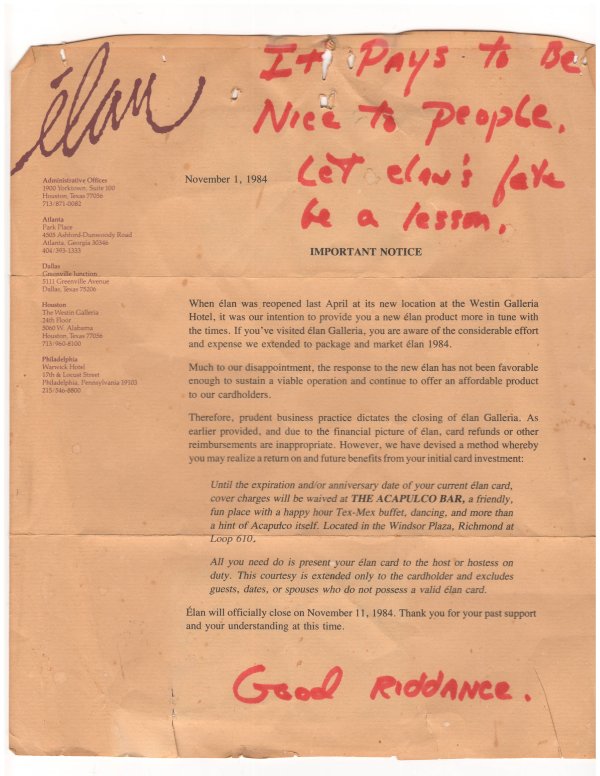
When I received
the notice that élan was closing, I sniffed
with contempt. I pulled out a permanent marker and wrote
a note: "It pays to be nice to people.
Let élan's Fate be a lesson."
I pinned that
note to my wall and looked at it every morning when I entered my
office as a reminder.
The same thing
happened to the Winchester Club. My
Black students knew better than go anywhere near this
redneck haven. On two occasions I had Asian students turned away.
In addition the management and customers alike subjected my
students to intense and quite unnecessary hostility.
Another example
of how NOT to stay in business was provided by Lance
Stevens, my former boss. He was a gifted teacher who possessed the knowledge
necessary to train someone to win a Ballroom dance contest. But
his attitude towards less talented students was horrible. He had no patience for
beginners and his constant sarcastic remarks made his
students cringe.
I am sarcastic too, but I use it to
make people laugh. Stevens used his sarcasm to sting. If someone was not paying attention or made a
stupid mistake, he would bite their head off. Rather
than encourage his dance students, he preferred to constantly put
them down with snide comments. Stevens' business was
reduced to a shell of its former self due to his
constant negativity. Same thing for élan
and Winchester. Their demise was the direct result of rudeness and
meanness.
|
 |
That said, it is
not easy to remain constantly upbeat. SSQQ
suffered growing pains in 1982 and so did I. Due to
the changes I made that year, I received more criticism in
1982 than I had in the previous four years combined. Throughout my
career I did my best to remain true to my vow to show
respect and gratitude. However, in 1982 there were
times when my patience grew thin. Due to my inability
to handle criticism well, I was far from perfect in
customer relations. That became the next frontier for
me to master.
|
Thanks
to Scott, during the summer of 1982 I
made a firm decision to teach all my classes using
the Circle technique. To make this work, I began to insist
that everyone switch partners throughout the class.
'Switching partners' led to more complaints than any
studio decision I ever made. There were a lot
of people who came with a partner and wanted to keep
it that way.
As the
studio grew, so did the complaints and so did my
headaches. Not fun. On the other hand,
problems led to solutions. Each improvement
helped the studio grow. However, I
did not enjoy being put in the position of
constantly enforcing the new status quo. The
irony was not lost on me. I was always the rebel as a
boy. I despised rules that had no apparent wisdom behind them.
For example, throughout high school I engaged in a running
battle with the Dean over the length of my hair.
He wanted it short, I wanted it long. I fought
the law and the law won. I set a record in my
Senior Year for trips to Saturday morning Detention
Hall.
Given my
tempestuous past, I
found it highly ironic that a non-conformist like me found
himself in an authority position. The larger my studio
became, the tougher it was to keep all the wild ponies headed in
the same direction. V-Ann was not the type to say no,
so that left it to me to be the bad guy. On any given
night
there were three or four complaints regarding one or another of my rules. Increasingly forced to
start class late while I dealt with issues, thank goodness I
had assistants to play music and interact with the class while I put out
fires.
I found
myself being worn down and losing my patience.
I called it 'death by a thousand paper cuts'.
Unskilled at the art of diplomacy,
I began to get into arguments which led to heated
(and time-consuming)
discussions. One night, an older gentleman
named Rudy told me I was being too sensitive to
criticism. Immediately I caught myself
bellowing, "Whaddya mean I'm too sensitive to
criticism!?!" His reply surprised me.
"Rick,
criticism is a compliment. Criticism means that
people care. If a student makes a mistake and you
do not correct it, then the student realizes you do not
care enough to see them improve. From what I
gather, most of the complaints you have told me about
are made by people who care about the studio and want to
see it become even better than it is already. My
suggestion is you listen to what they have to say.
Don't argue. Simply ask permission for time to
think about it and leave it at that. Then be sure
to think about it because they are bound to come back
and ask about your decision."
I nodded.
Rudy was correct. I needed to quit
arguing so much. This led to a new approach. One
day I took the time to write the House Rules down on paper.
Under each rule, I briefly explained the thinking behind the rule so
each student could evaluate it. I posted the Rules on
the walls and left plenty of brochures
laying around.
|
|
|
TEN MINUTE BREAK
starts at 8 pm, 5:30 for Weekend classes |
Common courtesy explains why
we ask you to stay in your classroom until Break Time.
If you leave class early to walk through any room, you interrupt their
class.
|
CHILDREN
are not permitted at the studio |
SSQQ is a Playground for
ADULTS.
Kids have no place being here nor is there any free space to put them.
|
EXCEPTIONS
must be arranged in advance. |
We understand that no one can know all of
our Policies ahead of time.
To ease tension, we have created the Exception Policy.
Ask Rick Archer
|
GUESTS
are not permitted without prior email
permission |
We DO Allow
Guests. However we DO NOT Allow Guests who show up at the studio without
any warning. A
phone call to Rick Archer IN ADVANCE solves the problem.
|
CLASS
RECEIPT
must be brought each week |
A movie requires a ticket and
a ticket taker. SSQQ is no different.
If you lose your receipt, we will verify your class by computer on the
premises.
|
TUITION FOR GROUP CLASSES
cannot be switched to Private Lessons |
This is the most obscure rule we have, but
twice a year someone asks anyway.
Ask Rick Archer to explain the reasoning.
|
REFUNDS
must be done ON FIRST NIGHT |
You have till the end of the first hour on the FIRST NIGHT of class to ask for your Refund.
You must ask for it at the
studio.
|
REGISTRATION
after Week Two is not permitted |
In Week Three, you have
arrived at the movie when it is half-over.
It is not fair to the class to have the teacher waste valuable time catching
you up.
|
SWITCHING PARTNERS
in all Group Classes is
mandatory |
Group Dance Classes teach you
to lead or follow EVERYONE. Plus the Instructors rotate partners just like
you do. Don't want to switch? Take
Private Lessons
|
WATCHING
is not permitted |
SSQQ is a School. We
are not a Zoo.
It is unfair to our students to have strangers watching them during
class.
|
RUDENESS
to REGISTRARS and INSTRUCTORS will not
be tolerated |
Registrars and
Instructors are expected to enforce the Rules. They don't make the Rules
and cannot change them.
Abusing them for doing their job is the stuff of bullies.
|
Anytime someone wanted to argue, I
handed them the House Rules brochure. Did this work? I won't say my
brochure solved the complaints entirely, but over time
the students did adjust to the House Rules.
Mostly it was the newcomers who gave me trouble.
They always wanted to stand there and discuss it,
but I did not have time to discuss it. It was
time to start class. After more delays than I
was willing to tolerate, I developed secondary
brochures in addition to the House Rules complaint.
Let's say a married couple wanted to stay with their
spouse during class. In addition to the House Rules
brochure, I would hand them a more detailed paper
such as "The Reasons for Switching". I
also developed specific brochures regarding Refunds,
No Children, No Watching, and so on. I would
say class was about to start and I did not have time
to discuss it, but read this over and I would talk
to them about it at Break or after class.
What was
the point of the secondary brochures that dealt with
a specific problem? A major reason people
ignore rules is that they do not understand the
reasoning behind the rule. By writing out my
reasons for making the rule, I hoped my students
would see my point. Did my brochures
work? Kind of. It is not that easy to
stick to your guns in certain situations. There were stories that
tugged at my heart. For example, someone's
sweet grandmother from Seattle was in town and was
just dying to watch her beloved granddaughter in
action. It would do very little harm to let
granny watch. Furthermore, it was a loyal
student doing the asking. Or someone's
babysitter failed to show, so a mother brought her
three children along and threw herself on my mercy.
What should I do?
Bend the rules? Stick to the rules?
|
THE RIGHTS OF THE
INDIVIDUAL VERSUS
THE RIGHTS OF THE GROUP
|
What this boiled
down to was a yearlong meditation on the rights of the
individual versus the rights of the group.
Some rules are
more important than others. My rules were not terribly
important. For my dance
studio to operate properly, I constantly found myself in the
awkward position of defending rules that in reality
were not very important.
If you speed, you could kill
someone. However, if you bring a friend along to watch
your dance class, no one is likely to be hurt.
If you drink alcohol and drive, you could kill someone.
If you forgot to bring your receipt to dance class, so what?
If you drive on the wrong side of the road, you could kill
someone. If you decide not to switch partners, who
cares?
If you forget to put your seat belt on, you are at the
complete mercy of the idiot who sideswipes your car.
If you bring your child along with you to class, why should
that matter? People are used to
disruptions.
If you run a red light, someone could get killed, maybe even
you. But if you leave your cell phone on (a 21st
century problem) and it goes "ring ring ring" in the
middle of class, big deal. It might be an important
call.
Since SSQQ House Rules were cosmically inconsequential, some
of our students disobeyed them when it was
convenient for them to do so. The excuses were all the
same.
What
difference does it make?
Who cares?
What if I promise not to do this again? Just this
once.
I saw someone else do this exact thing last week.
One of the other teachers said it would be okay not to
switch partners.
Can't you make an exception?
SSQQ House Rules
by the very nature of our business were just begging to be
broken by someone with a will to do so. For one thing,
the harmful consequences of breaking our rules was very
small. For example, I openly agreed it would not hurt much
to let someone's kid sit there and watch for one night,
especially if he was quiet.
In addition, I was in the position of trying to please my
customers. I depended on my customers to help me stay
in business. So why should I insist on sticking to our
guns??
Take for example the legend of the
little Dutch boy who stuck his finger in the hole of the
dike. Without his timely intervention, the mighty
North Sea would erode the hole, thereby risking the entire
structure to collapse from erosion. By sticking his finger at
the source of the leak, he stopped the flow of sea water
from tearing down the dike until help arrived to
patch it. Of course the first little 'drip, drip,
drip' of water would not matter. But if left
unchecked, slowly the hole would widen until it becomes a
difficult problem to stop, thereby magnifying the danger.
In our case, ignoring each small indiscretion risked tempting
other students to do the same thing. Each time I made
an exception or looked the other way, I risked allowing the
hole in the dike to widen.
 If there is
a guest sitting there watching the
class, don't you suppose some students will be
uncomfortable? If there is
a guest sitting there watching the
class, don't you suppose some students will be
uncomfortable?
If there is a couple who refuses to switch, there are
other students in the room who also would prefer not to
switch.
If there are children in the room, don't you suppose
other parents would like to bring their kids along?
If someone is smoking, need I say more?
If a person starts in the third week of class and
doesn't have a clue what is going on, don't you suppose
every student will resent how their
presence slows the class down?
I could not
agree more that if something happened occasionally, no big
deal. But one day I learned my lesson the hard way (I
will share the story shortly). I discovered that
making an exception for one person caused other people to
disregard the rule, thereby causing the 'disobedience'
to become more wide-spread. I was dealing with the
well-known problem of "if I let one person do it, then I
have to let everyone do it." The moment
students who have cooperated see how little respect others
have for our Rules, first they get angry at me for not
having the guts to stick to my guns, then they are more
willing
to challenge the Rules when it suits them.
"I
believe each individual is naturally entitled to do as
he pleases with himself and the fruit of his labor, so
far as it in no way interferes with another man’s
rights." – Abraham Lincoln
Let's face it: Having kids run around the studio, having
cell phone conversations everywhere, having guests in every
room, and having couples who don't switch partners would
definitely "interfere with the rights of our other
customers". Whenever I made one student happy,
I risked making other students unhappy.
Furthermore, even if I did give in to a student, I risked
losing his respect
too. A student would know from this point on that our Rules
were meaningless. Damned if I do, damned if I don't.
Ultimately I
learned how to explain that the rights of the group are more
important than the rights of the individual. If a
student decided to punish me for sticking to my guns
by leaving the studio, then that was a risk I would have to
take.
|
RULES
ARE MADE TO BE BROKEN: EXCEPTIONS
|
EXCEPTIONS
must be arranged in advance. |
We understand that no one can know all of
our Policies ahead of time.
To ease tension, we have created the Exception Policy.
Ask Rick Archer
|
One
night Connie shows up with her new
boyfriend who wants to watch her class. Of course
I frown. I know for a fact that a lot of my
students dislike having some stranger
observe them making their inevitable mistakes. So
I point this out. Does it work? No.
Well aware that I am uncomfortable saying no, Connie
proceeds to work me.
"But,
Rick, my boyfriend really wants to sign up.
Jack told me if he could just see how your
classes work, he would start next month.
Can't you make an exception for him??"
Meanwhile Jack is standing there watching the
transaction go down. The moment Connie offers
her punch line, he nods accordingly. So I back
down and tolerate the indiscretion. Does Jack
show up next month for class? Maybe yes, maybe
no. But when this kind of situation kept
repeating, the day came when I grew tired of giving in. So I went back
and added another Rule.
"Exceptions
will only be made if asked for in advance."
Did this
work? Yes. People did actually phone me
and explain what they needed. But my Rule was
sabotaged by an unwritten Rule that many of my
students firmly believed in. "Rules are
made to be broken."
It is
the start of class. The Registrar says I am
needed at the front desk. This is the night
Sylvia shows up with her three children. Her
babysitter has failed to appear and Sylvia does not
want to miss her class. I roll my eyes.
What are we, a daycare center? I proceed to
explain the 'No Children' rule. I tell
Sylvia that the presence of children forces adults
to behave like adults when deep down they prefer to
behave like frisky teenagers.
The
beleaguered mother nods and says she understands,
but, gosh, her kids are already here. "Surely
you are not going to make me leave and take my
children home. Please? Pretty Please?
Surely you can make an exception this one time."
Now it
is time for me to explain to Sylvia that Exceptions
must be asked for in advance.
"But,
Rick, that doesn't do me any good. How was
I supposed to know the babysitter would stand me
up? I need
the exception now, not later!"
How many
times did I hear that? But Sylvia has given me
an idea. She said, "Surely you can make an
exception this one time..."
Hmm.
Maybe I can make an exception this one time.
So now I make a new rule. "One Exception
may be
granted to each student per year." I
pull out a piece of paper, then write "Exceptions List"
at the top. Then I add Sylvia's name, the date
and make her initial it.
Sylvia
smiles and catches on. Believe it or not, this
worked. Sylvia got what she wanted and she
never brought her kids to class again. But
that was not the end of the story. As Sylvia
brought her children into the room, I explained to
the class that I was making an Exception this one
time only because it was a small emergency of sorts.
No one complained. Many of them were parents
themselves, so they understood. More
important, they liked the fact that I explained WHY
I HAD BROKEN MY OWN RULE.
I was
nowhere near a master at politics, but I was getting
better. The important thing is that my
students could see I was trying hard to be fair.
Realizing these rules were made for the good of the
studio, the vast majority cooperated voluntarily.
|
|
|